
Testosterone Is Venture Capital: Why the Body Funds Winners, Not Strugglers
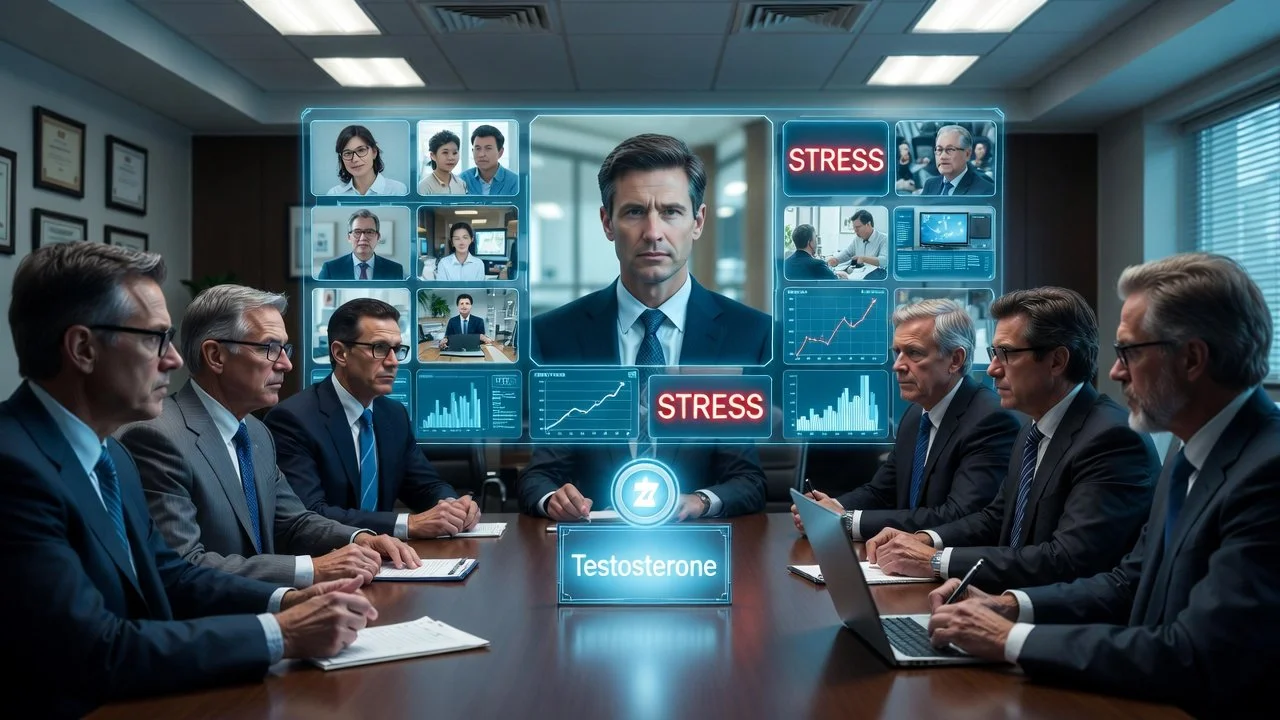
Most men think testosterone is something you earn.
Lift heavier.
Wake up earlier.
Push harder.
Grind longer.
And when energy doesn’t show up, they assume they’re broken.
But testosterone doesn’t work like a paycheck.
It works like venture capital.
Your body isn’t paying you for effort.
It’s deciding whether you’re worth investing in.
Take my current situation: one of my daughters is keeping me up late into the night with an issue, and I have to be up early to help my other daughter get her day started. In between, I’m working full-time, grinding to build a better future for my family.
Logically, this is when I need energy the most. This is when I need my body to "pay out" the drive to keep going. But I can literally feel my testosterone dropping. I feel flat, drained, and the energy just isn't there.
It feels like a betrayal. But from a biological standpoint, it’s a strategic withdrawal of funds.
The Strange Problem of Low Energy When You Need It Most
Here’s the paradox:
The moment your life becomes unstable (emotionally, socially, psychologically) is often the moment your energy disappears.
You feel flat.
Unmotivated.
It feels cruel.
Because shouldn’t energy increase when life gets harder?
Evolutionarily, no.
When outcomes become uncertain, your body doesn’t double down, it de-risks.
And anabolic hormones like testosterone are expensive.
Testosterone Is Not a Reward Hormone
This is the first belief that has to die.
Testosterone is not:
A reward for discipline
A badge for suffering
A motivational chemical
Testosterone is an investment hormone.
The body allocates it the way an investor allocates capital:
When downside risk is low
When future returns look plausible
When stability exists
If your nervous system predicts:
Loss
Chronic threat
Stagnation
Unrecoverable failure
It pulls funding.
Not because you’re weak, but because it’s rational.
Acute vs Baseline Testosterone (Why Most Advice Fails)
Most online testosterone advice collapses two very different things into one.
Acute testosterone
Short-lived spikes
Triggered by:
Heavy lifting
Competition
Sexual cues
Last minutes to hours
These spikes feel good.
They do nothing long-term.
Baseline testosterone
Your long-term hormonal operating level
Determines:
Energy
Libido
Recovery
Drive
Confidence
Baseline testosterone changes slowly and conservatively.
This is why:
One workout doesn’t fix you
One insight doesn’t change you
One “alpha mindset” doesn’t work
Your body isn’t gullible.
Resistance Training Doesn’t Raise Baseline (But It Still Matters)
This is another uncomfortable truth.
If you’re already healthy, resistance training:
Rarely raises baseline testosterone
Even when done perfectly
What it does do:
Increases androgen receptor density
Makes tissues more sensitive to testosterone
Improves output per unit hormone
Think of it like improving operational efficiency, not raising funding.
This is why:
You can build muscle without raising baseline T
Strength improves before mood does
Fitness influencers overpromise hormonal effects
The lever most people pull isn’t the one that controls capital allocation.
The Hard Truth: You Don’t Really “Raise” Baseline Testosterone
Here’s the line most people never say out loud:
You almost never raise baseline testosterone above its natural set point.
Baseline testosterone is:
Genetically constrained
Evolutionarily conserved
Actively defended by your endocrine system
What people call “raising baseline” is almost always this:
Removing chronic suppression.
And the difference feels dramatic.
How Baseline Testosterone Actually Changes (A Clean Timeline)
Phase 1: Suppressed Baseline
This is where most struggling men live.
Causes:
Chronic psychological stress
Loss of agency
Persistent threat vigilance
Sleep disruption
Overtraining
Social instability
Identity collapse
Biologically:
Cortisol dominates
Dopamine tone drops
Serotonin inhibitory signaling rises
Testosterone is suppressed
Your body isn’t failing.
It’s entering capital preservation mode.
Phase 2: Restoration to Natural Baseline
When suppression is removed:
Testosterone rebounds
Energy returns
Libido resurfaces
Motivation stabilizes
This feels like a boost above baseline.
But it isn’t.
It’s your body saying:
“Okay. Risk has decreased. I’ll invest again.”
Most success stories stop here and claim optimization.
They’re really describing recovery.
Phase 3: Healthy Baseline
Once restored:
Further lifestyle changes improve signaling
Sensitivity improves
Outcomes improve
But baseline itself does not keep rising.
This is where frustration returns, because expectations were wrong.
The Only True Ways to Exceed Natural Baseline
There are exactly two:
TRT
SERMs (e.g., clomiphene, under medical supervision)
Everything else:
Protects baseline
Restoration of baseline
Sensitizes tissues
Testosterone isn’t boosted, it’s freed.
Suppression Is About Threat, Not Rank
Here’s where psychology matters.
Suppression isn’t caused by “low status.”
It’s caused by:
Chronic unpredictability
Persistent vigilance
Lack of agency
Repeated negative prediction errors
Status only matters insofar as it:
Reduces threat
Stabilizes outcomes
Creates internalized confidence of position
Going from low→ high status can raise testosterone long term only if it removes suppression.
Not because status is magic.
When the World Stops Making Sense
This is where personal experience becomes explanatory.
When I lost my girlfriend in college, it wasn’t just emotional pain.
It was model collapse.
The assumptions I had about:
Relationships
Predictability
My place in the world
All broke at once.
My nervous system entered:
Threat vigilance
Re-analysis mode
“Rethink how the world works” mode
That state is incompatible with anabolic investment. Not because heartbreak is weakness, but because uncertainty is expensive.
It took time, but eventually, I started rebuilding my world. I began to form a new world view, one that accepted the loss but found new avenues for agency and predictability. The moment that new "business model" for my life stabilized, I started to come alive again. The energy returned because the body finally saw a roadmap it was willing to fund.
Testosterone Is Not an Effort Hormone
This is where “grind culture” collapses.
Effort under safety:
Builds confidence
Signals growth
Supports investment
Effort under threat:
Elevates cortisol
Signals desperation
Increases risk
Testosterone follows confidence of success, not intensity of effort.
Grinding without stability tells the body:
“This is not working.”
So it pulls funding.
Why the Body Pulls Anabolic Investment When You’re Losing
From an evolutionary perspective, this is obvious. Anabolism increases risk-taking, reduces immune function, and costs immense amounts of energy. If you’re losing repeatedly with no trajectory shift, more testosterone won’t save you, it will get you killed.
This logic is rooted in the "Winner Effect," a biological phenomenon explored deeply by Ian Robertson. He notes that winning a contest increases testosterone, which in turn increases the number of androgen receptors in the brain. This makes the organism more sensitive to future testosterone, creating a compounding loop of confidence and success. Winning literally changes the brain's "investment profile."
Robert Sapolsky expands on this in Behave and Why Zebras Don’t Get Ulcers, focusing on the inverse: the devastating "Cost of Submission." When an organism is chronically stressed or low-status, the body switches from a growth-oriented "Anabolic" state to a survival-oriented "Catabolic" state.
Glucocorticoids (like cortisol) start breaking down tissues to provide immediate energy for a threat that never disappears. In this state, the body views testosterone as a luxury it can no longer afford. It’s the biological version of a company liquidating its R&D department just to keep the lights on during a recession.
Your endocrine system is Bayesian.
It updates based on repeated, multi-channel evidence.
One-off thoughts don’t work.
Patterns do.
A Strategy That Actually Works
Not motivational.
Not affirmational.
Biological.
Step 1: Reduce Chronic Threat
Lower noise. Shrink obligations. Stabilize sleep. Stop bleeding energy.
Step 2: Restore Predictability
Same routines. Same inputs. Same outputs.
Step 3: Shrink the Game
Choose arenas you can win now, not later.
Step 4: Accumulate Micro-Wins
Small successes compound belief faster than grand visions. “Make your bed”.
Step 5: Maintain Agency
Even at your ceiling, autonomy preserves anabolic signaling.
The Strategy in Action: The Job Loss Crisis
Imagine a man who has just lost his job. He is spiraling. The threat is massive: How will I provide for my family? His body senses the high-risk "recession" and pulls the T-funding. He feels paralyzed.
If he follows the biological strategy, he doesn't start by trying to launch a new business from scratch in 48 hours, cold-emailing 50 CEOs in a night, or demanding a massive interview. Those are "Hail Mary" plays that carry massive threat of failure and signal desperation to the nervous system.
Reduce Threat: He stops checking LinkedIn every 5 minutes and limits his "job hunting" to 4 specific hours a day. He stops doom-scrolling.
Restore Predictability: He wakes up at the same time he did for work. He wears a collar. He creates a rigid daily schedule. His body sees a "routine" and starts to de-escalate the emergency.
Shrink the Game: Instead of "Fixing my whole career," he focuses on "Optimizing one section of the resume today."
Accumulate Micro-Wins: He completes a small certification or fixes a leak in the sink, something with a 100% success rate. This triggers a tiny "Winner Effect."
Maintain Agency: He exercises. He controls his body because he can't control the market yet.
By doing this, he isn't "finding a job", he is pitching his body to reinvest. Once the baseline stabilizes, the energy to actually execute on the high-stakes opportunities finally returns.
You don’t convince the body.
You show it evidence.
The Final Reframe
You are not a broken machine.
You are a business owner pitching your life to an investor that doesn’t care about words.
Your body isn’t withholding testosterone to punish you.
It’s protecting itself from bad investments.
Stability earns capital.
Safety precedes strength.
Momentum unlocks energy.
And when the body believes you’re building something that can win —
It funds you.
Thanks for reading my stuff,
MJ