
Hair Loss Isn’t a Hormone Problem. It’s a Mechanical One
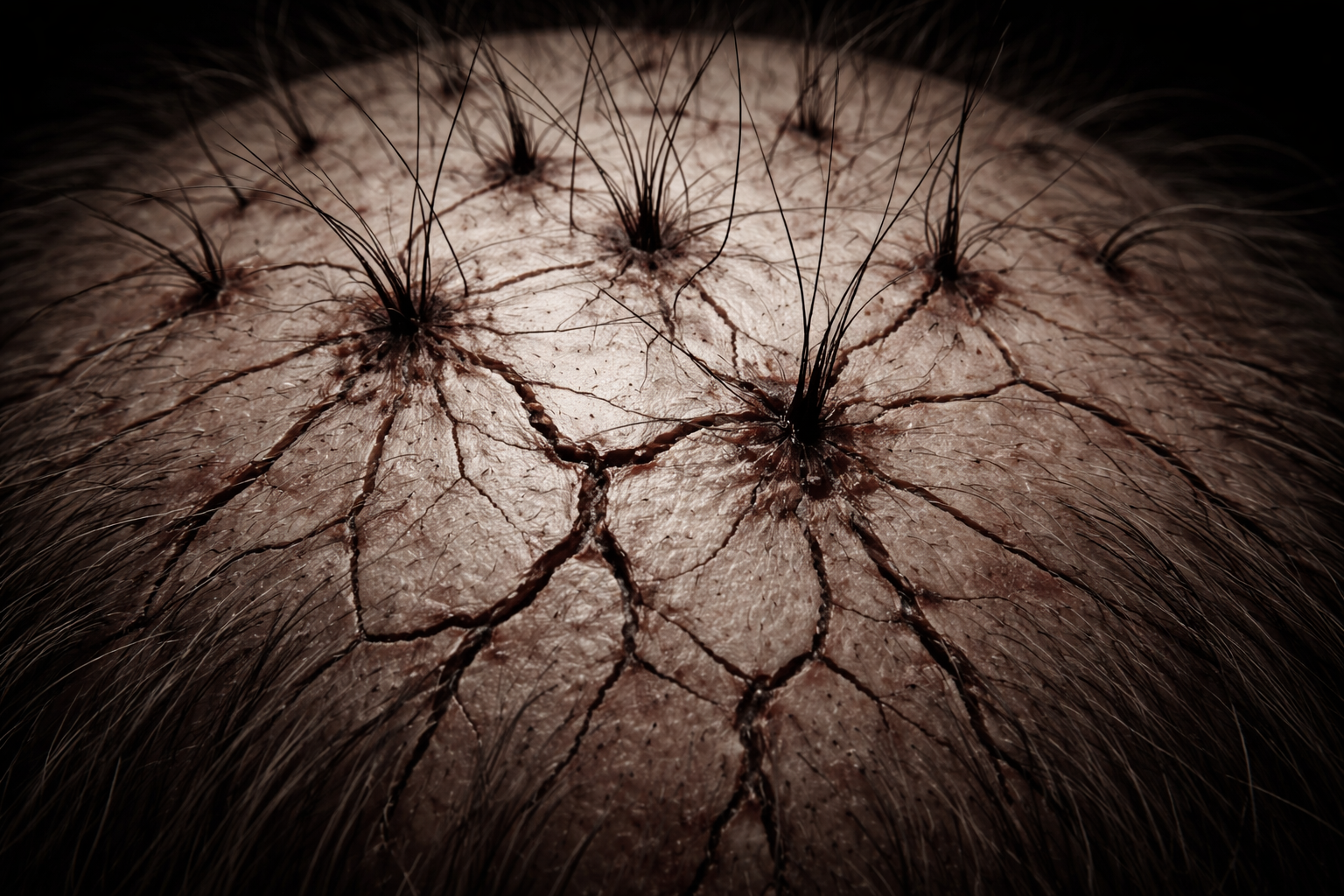
I first noticed it when the light hit the mirror at just the right angle, a subtle shift in my hairline, a slight transparency where there used to be density. That first realization is a gut punch. Your mind immediately pivots to the same desperate questions we've all asked: "Why is this happening to me? Is it just bad luck? It’s just DHT, right? Block it and I'm done."
If you’re reading this, chances are you’ve had that moment.
You catch your reflection in a window, notice the temples pulling back a little more, the crown looking thinner under harsh light. A quiet panic sets in. You open your phone, fall down the rabbit hole: finasteride horror stories about brain fog and libido crashes, minoxidil sheds and potential heart palpitations that make you look (and feel) worse before (maybe) better, endless “miracle” shampoos and supplements that do nothing but empty your wallet.
You’re not crazy for feeling this way. Hair loss is deeply personal. It’s not just cosmetic, it attacks identity, confidence, how you carry yourself in conversations, dates, photos, job interviews. It feels like losing a piece of who you were, and the mainstream solution (“it’s DHT, take this pill”) often leaves people more frustrated than fixed.
The uncomfortable truth most dermatologists gloss over: DHT isn’t the villain igniting the fire. It’s the firefighter showing up to a blaze that’s already burning.
And the real blaze? Chronic mechanical tension on your scalp.
Most men treat hair loss like a straightforward hormone equation. They miss the mechanical reality that’s literally pulling on their head every single day.
The Root Cause: Scalp Tension – The Hidden Mechanical Trigger
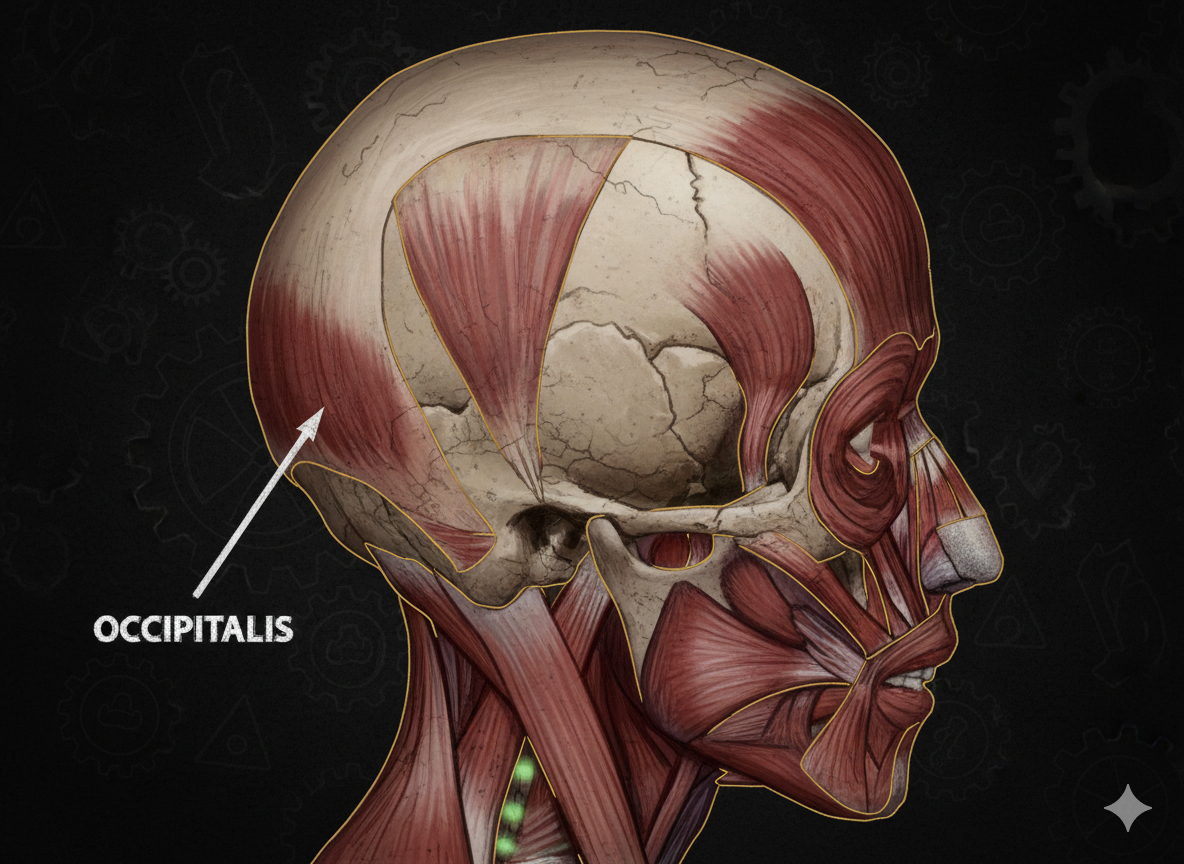
Underneath your scalp skin lies a tough, fibrous sheet called the galea aponeurotica. Think of it like a drumhead stretched tight across the top of your skull, anchored at the edges by a ring of muscles: the frontalis (across your forehead), the occipitalis (at the back of your head), and the temporalis (around your temples).
When these perimeter muscles stay chronically contracted, whether from genetics, skull expansion, posture, or stress, they pull. The galea tenses like an over-tightened drum. Blood vessels get compressed. Oxygen delivery drops (hypoxia). Low-level inflammation kicks in. Your body, attempting to protect the tissue from this stress, ramps up local DHT production as a protective response—acting as the "firefighter" mentioned earlier, arriving at a blaze it didn't start. That DHT then triggers TGF-β1, the key protein responsible for building perifollicular fibrosis—the dense scar tissue that literally buries hair follicles alive.
Follicles get choked. They miniaturize. They shift into resting phase sooner. Eventually, they go dormant and die.
The classic male pattern baldness shape, temples receding, crown thinning first, isn’t random. It maps exactly to the zones of highest mechanical tension on the galea.
This isn’t some obscure theory anymore. It’s backed by real research: studies on mechanical stress correlating with balding patterns, Botox trials showing measurable regrowth after relaxing those same muscles, and microneedling data proving that reducing fibrosis directly improves hair density.
DHT is downstream. Tension is upstream. Fix the pull, and you short-circuit the whole cascade.
What Actually Causes This Tension? (And Why Evolution Didn’t “Fix” It)
The dominant trigger is post-pubertal skull growth. Starting in your teens and continuing into your 20s/30s, your skull bones (frontal and parietal especially) expand unevenly, influenced by androgens like testosterone and DHT. The galea gets stretched permanently. The perimeter muscles have to work harder to hold everything in place. Chronic tension gets locked in for life.
Genetics decide how much this hurts you. Some men inherit naturally tighter, more contractile scalp muscles that amplify the pull. Others get lucky with looser ones.
Gravity never lets up: constant downward force on the scalp skin squeezes tissues over decades, especially as the natural cushioning (subcutaneous fat) thins with age.
Modern habits pile on: forward head posture from hours staring at screens tightens neck and scalp muscles even more, creating extra strain.
Chronic stress keeps muscles involuntarily clenched. Diets high in sugar and processed food fuel systemic inflammation that makes the local scalp environment more hostile.
Why hasn’t evolution eliminated this?
Because reproduction happens first.
In ancestral environments (and even today in many places), peak fertility and mating happen in the teens and 20s. By the time MPB becomes noticeable in your 30s or 40s, you’ve already passed on your genes. High-testosterone traits, like robust skull growth, the strong brow ridges that anchor your scalp’s perimeter muscles, and muscular development, likely helped you compete, attract partners, and survive early life. Baldness is just the delayed side effect.
It’s not a design flaw. It’s a trade-off evolution was fine with.
The Brutal Reality: Prevention Is 10× Easier (and More Effective) Than Restoration
Once follicles are encased in thick, mature fibrosis for years, restoration becomes a steep uphill battle. At that stage, the biological machinery is often too choked by scar tissue to be salvaged by natural means alone.
The real leverage is prevention.
Catch it early, when thinning is subtle, when your scalp still feels pliable and movable, and you can interrupt the tension-inflammation-DHT-fibrosis loop before it becomes irreversible.
Proven, evidence-backed prevention tactics:
Daily scalp massage (10–20 minutes, morning and night): Use your fingertips to deeply loosen the frontalis, occipitalis, and temples. Add neck, shoulder, and jaw stretches. A large 2019 self-reported survey of nearly 2,000 people found consistent massage led to thicker hair and reduced shedding. It’s mechanical tension relief in its purest form.
Anti-inflammatory lifestyle: Prioritize berries, leafy greens, fatty fish, nuts, green tea, turmeric. Slash sugar and processed carbs. These directly lower TGF-β1 and systemic inflammation.
Oxygen & circulation boosters: Try brief inversions (head below heart 1–2 minutes), daily walks or light exercise, cool water rinses after showers. Hypoxic follicles revive when oxygen returns.
Posture & habit fixes: Train yourself to sit/stand tall. Use blue-light blockers at night. Wear hats only if they’re loose.
Consistency here stops progression for many or at least slows it down. Tension-theory communities are full of guys who report their scalp feeling “looser” and shedding slowing within 3–6 months.
Restoration: What Actually Works When You’re Already Thinning
If miniaturization has begun, go more aggressive:
Microneedling (0.5–1.0 mm depth, once weekly): This creates micro-trauma that triggers collagen remodeling, reduces fibrosis, and releases growth factors. Clinical trials show 82% of users see major improvement when combined with topicals, far better than topicals alone.
Rosemary oil (applied post-needling): Dilute 5–10 drops in a carrier like jojoba or coconut, massage in deeply. The landmark 2015 randomized trial found it performed as well as 2% minoxidil for hair count increase, with significantly less scalp irritation. It lowers TGF-β1 (preventing new fibrosis), improves circulation, and may reduce local DHT sensitivity.
Next-level options: Botox injections into scalp muscles (pilot studies: 18%+ hair count gains after months). Supplements like NMN or NAD+ precursors for mitochondrial support in follicles (early but exciting data).
The killer stack: weekly microneedling to mechanically break up scar tissue + daily rosemary massages to protect and stimulate. Track progress ruthlessly, monthly photos under consistent lighting.
Patience is non-negotiable. Hair cycles are slow. Expect 3–12 months for visible change.
The Future: Hair Follicle Cloning – The Endgame
We’re on the cusp.
Companies like Stemson Therapeutics and dNovo are perfecting hair follicle cloning. The process: harvest a few healthy follicles from the back of your head, multiply them by the millions in a bioreactor using your own cells, then implant them back into thinning areas.
No donor-site limitations. No rejection risk. Natural, permanent density.
Clinical trials are advancing rapidly (2025–2026 updates show strong preclinical and early human data). Realistic timeline for broad availability: 5–10 years.
Until then, your best move is mastering prevention and natural restoration.
Key Takeaways
DHT is a downstream response, not the root cause. Chronic scalp tension (from skull growth, muscle pull, gravity) is the upstream mechanical trigger.
Evolution preserved MPB because it activates after peak reproduction. High-testosterone genes were selected for, baldness is collateral.
Prevention is exponentially easier than restoration. Prioritize daily massage, posture, anti-inflammation, and circulation now.
For active thinning: microneedling + rosemary oil is one of the strongest natural stacks available today.
The future belongs to cloning, protect what you have so you have less to replace later.
Hair loss isn’t random bad luck.
It’s a signal your scalp has been under chronic mechanical stress for years.
Stop ignoring the signal.
Start acting on it.
Your future hairline, and the version of you that looks in the mirror without wincing, depends on the habits you build today.
What are you waiting for?
Grab five minutes tonight.
Start the massage.
Work less on excuses.
Build the scalp health your follicles need to survive.
Own the head you want.
Thanks for reading my stuff,
MJ